
DMD Power Box
Installing the DMD Power Box, connect it to the battery and connect the ignition detection. Set it up in the app and start using it!

About Device
DMD Power Box is a power distribution box that allows you to remotely control up to 6 accessories from within the DMD2 app.
Ideal for managing accessories connected to your motorcycle, 4×4 or Overlander - heated gear, navigation accessories, auxiliary and ambient lights, horns, air compressors and much more.
It supports from 9V to 28V and each channel can handle up to 80A! Making it capable of handling any setup.
Use the C1 input for idle control (connect post ignition) and C2 input for creating rules or switching profiles.
Revision History:
No changes since release
Quick Reference
Box Contents
DMD Power Box
One fused cable to connect to battery (includes terminals)
One ground cable

Warranty
All our devices include a two years warranty.
For general questions and first instance support you can contact us directly. For hardware related issues and repairs you can also contact us directly if you are in EU and if you are outside EU you should contact the point of sale.
Certification
We make sure all our devices follow the regulations and norms of the different markets where we sell them.
Conformity & Compliance: CE, FC, IC, UKCA, RCM, RoHS Compliant, Reach Compliant, Weee.


Device Legend
Case lock screw (unscrew to open the lid to access connectors)
Channel state LED (when lit red it means the channel is powered)
Channel toggle (press it to turn the channel power on or off)
Pairing button - Press and hold it for 4 seconds to set the device in pairing mode (the LED will flash)
Channel connector - There are 6 output channels
12V / 24V Input - Connect it to your battery positive
C1 - Ignition detection - Connect it to a power source post ignition - this controls the power box state, when C1 receives power the power box will turn on, when C1 stops receiving power the whole power box will shutdown and all channels closed. We call C1 "idle detection", and at any moment the idle state can be disabled in the app, so that you can turn off ignition and keep everything powered.
C2 - Additional switch, you can use this input to create rules or change profiles, you can setup actions based on C2 input. For example, connect your high beams to C2 so that you can switch to a profile that turns on auxiliary lights, this way when you toggle your high beam the aux lights also turn on.
Ground, connect to battery ground.


Bluetooth Pairing
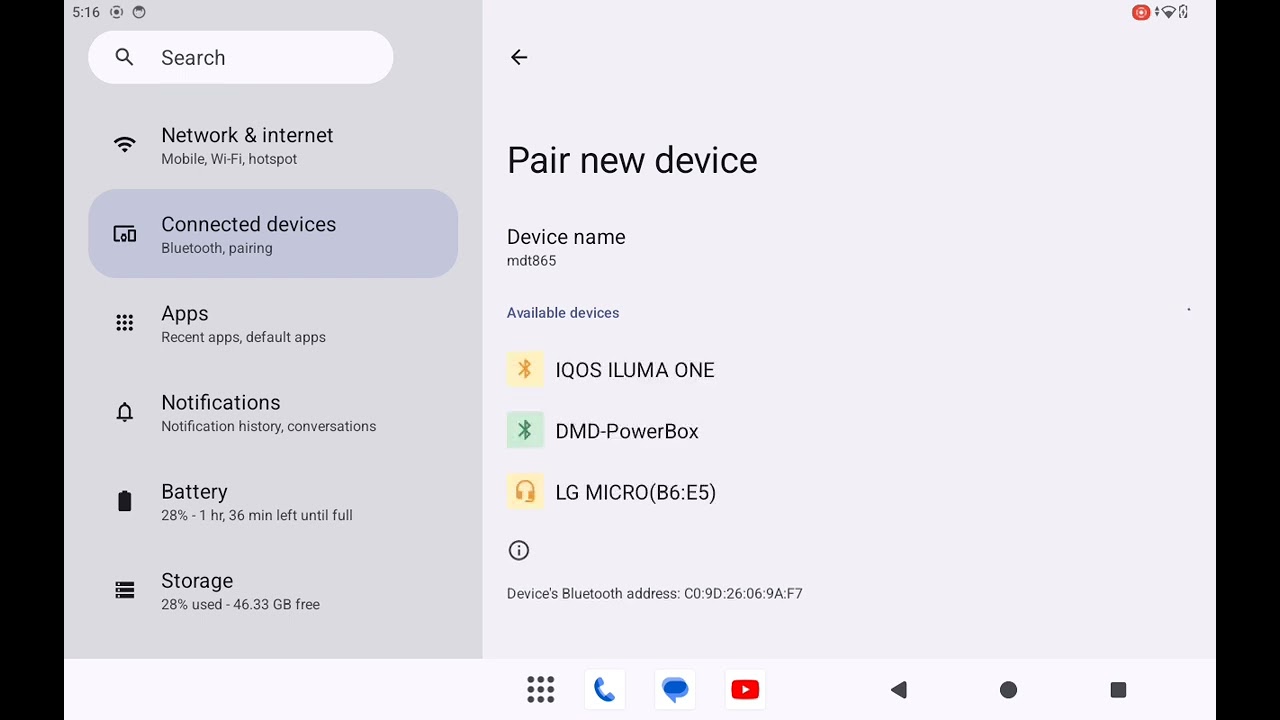
Open the Android Bluetooth menu in your device and go to “Pair new device”
Turn on ignition and make sure the Power Box is powered
Press and hold the “Pair” button until it flashes (minimum 4 seconds pressing it)
If the Power Box is turning on and then quickly turning back off it means no power is reaching the C1 input - which means it will trigger idle mode and shut down the box.
Setup DMD2
Pair the Power Box in the Android Bluetooth menu first (see Bluetooth Pairing above).
In DMD2, open Devices from the bottom menu and tap Add New Device > DMD Power Box, then tap your box (named “DMD-PowerBox”).
The Power Box card appears in Devices with your six channels. To switch them from the Home screen too, add the Power Box row to Home.
On a DMD unit with Mini Launcher, the launcher shows the same Power Box on its Devices page while it is on screen and uses the same settings, so you can change them in either app.

Ignition Detection
The Power Box is intended to be connected directly to the vehicle battery, for this reason we have a post-ignition detection that allows the power box to turn off and on when you toggle your vehicle ignition.
The C1 input is the input that is expected to receive 12V/24V post-ignition. When it receives power the Power Box turns on and brings back the channels it had; when you cut the ignition power (C1 no longer gets power) the Power Box turns off and shuts down all channels after some seconds.
Start every ride the same way: in the Power Box options, When the ignition comes on can load Profile 1 or Profile 2 instead of bringing back the last channels. DMD2 (or Mini Launcher) needs to be connected to the box when you switch off, so it sees C1 go off.
Notice: You can keep the Power Box turned on even after you turn off the ignition: switch Idle off on the Power Box card. This allows you to keep your devices running even when you turn off the ignition. Imagine you want to turn off your engine and control ambient lights while camping or to use your air compressor to set your tires pressure.
Power Box Card
Channels - tap a switch to turn its channel on or off; press and hold to rename it.
Idle - idle detection (C1) on or off. When it is off, the box stays on when C1 stops receiving power.
C2 - shows whether the C2 input is receiving power.
Profile - tap to load Manual (USR), Profile 1 or Profile 2; each choice lists the channels it turns on.
Tap the card's title to open the Power Box options.
The Power Box row on the Home screen has the same switches, with Idle, C2 and the profile in its header.


Power Box Options
Tap the Power Box card's title in Devices to open its options (in Mini Launcher, the gear on the Power Box tile). They are saved per rider profile and shared with Mini Launcher.
When C2 turns on / When C2 turns off - Do nothing, Load Profile 1, Load Profile 2, Turn a switch on or Turn a switch off. An action runs when C2 changes; reconnecting with C2 unchanged runs nothing.
Switch for C2 actions - the channel the switch actions drive. That channel belongs to C2: switching it never drops Profile 1 or 2 to USR, so your high beam can flash the headlight relay without leaving the profile.
When the ignition comes on - Keep the last switches, Load Profile 1 or Load Profile 2.
Profile 1 and Profile 2 - fixed presets: the state of each channel and of idle detection (C1).
Loading a profile sets every channel and idle detection. Change a channel by hand and the Profile button shows USR (manual); choosing USR brings back the channels as you last set them by hand. You can load a profile from the Profile button, with the C2 input, or when the ignition comes on.